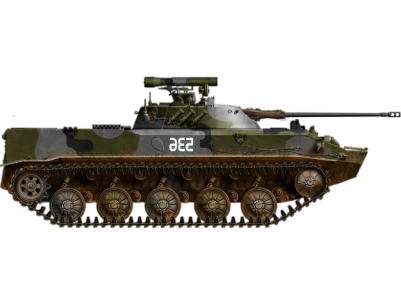
BMP-2
The BMP-2 (Boyevaya Mashina Pekhoty, Russian: Боевая Машина Пехоты, literally “infantry combat vehicle”) is a second-generation, amphibious infantry fighting vehicle introduced in the 1980s in the Soviet Union, following on from the BMP-1 of the 1960s.
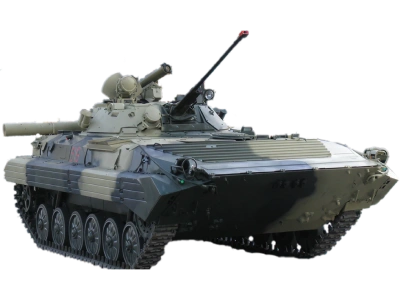
Product details
The BMP-2 is broadly similar to the BMP-1. The most significant changes are: The commander now sits with the gunner in an enlarged, two-man turret. Armament changed to the 2A42 30 mm autocannon and the 9P135M ATGM launcher capable of firing SACLOS guided 9M111 "Fagot" (AT-4 Spigot), 9M113 "Konkurs" (AT-5 Spandrel) and 9M113M "Konkurs-M" (AT-5B Spandrel B) anti-tank missiles. Only seven troops can be carried instead of eight. Two rear infantry roof hatches instead of four. Slightly improved armour. During its combat debut in the Yom Kippur War, Egyptian and Syrian BMPs proved vulnerable to .50 calibre machine-gun fire in the sides and rear, and to 106 mm M40 recoilless rifles. The 73 mm gun proved inaccurate beyond 500 metres, and the AT-3 Sagger missile could not be guided effectively from the confines of the turret.
| Note |
The technical characteristics may have minor differences according to the different manufacturers of the given product. The manufacturers reserve the right to make changes to the specified parameters. |
|---|
| Mass | 14.3 tonnes (15.8 short tons; 14.1 long tons) |
|---|---|
| Width | 3.15 metres (10 ft 4 in) |
| Secondary armament | 7.62 mm machine gun (PKTM) |
| Armor | 33 millimetres (1.3 in) (max) |
| Engine | Diesel UTD-20/3 - 300 hp (225 kW) |
| Power/weight | 21 hp/tonne |
| Suspension | torsion bar |
| Operational range | 600 km (370 mi) |
| Maximum speed | 65 km/h (40 mph) (road) or 45 km/h (28 mph) (off-road) or 7 km/h (4.3 mph) (water) |
| Note |
Main armament: Turret with 30 mm autocannon 2A42 and 9M113 Konkurs ATGM or B05Ya01 Berezhok turret with 2A42 32mm autocannon, PKMT 7.62mm coaxial machine gun, AGS-30 grenade launcher, and 9M133M Kornet-M ATGM |
|---|
Related Tactical Choice
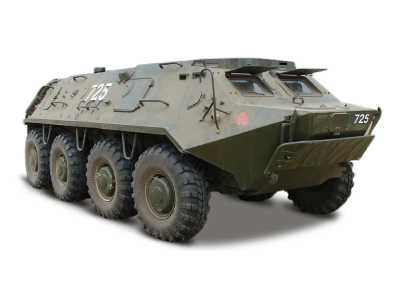
BTR-70
Leopard 2
BTR-80